
Metric nut dimensions: hex, thin, lock, flange and cap nuts
The plain hex nut, its thin version, the nylon insert lock nut, the flange nut and the domed cap nut, all with coarse metric threads. The chart compares their wrench size and height; each nut has its own page with the full table and a CAD file for every size.
Metric hex nut types by standard
-
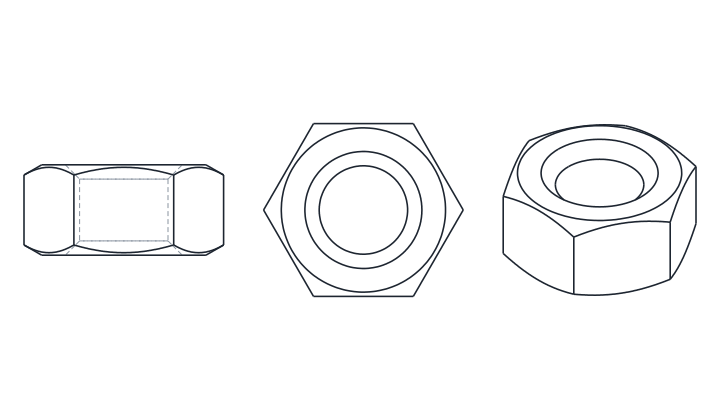 ISO 4032 / DIN 934 hexagon nutHexagon nut, style 1, with coarse metric thread, from M3 to M24.
-
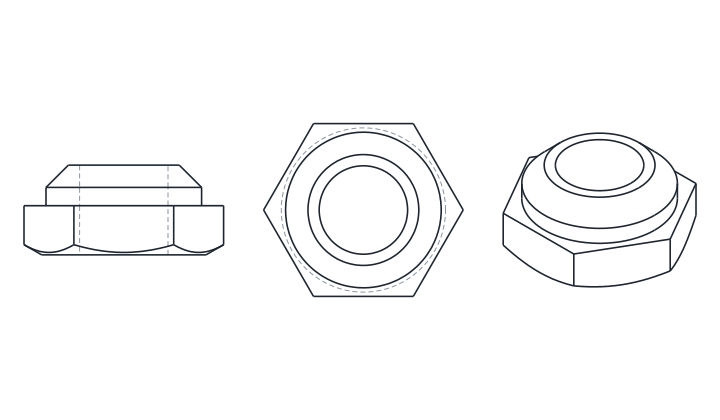 ISO 10511 / DIN 985 nylon insert lock nutPrevailing torque hexagon thin nut with a non-metallic insert, from M3 to M24.
-
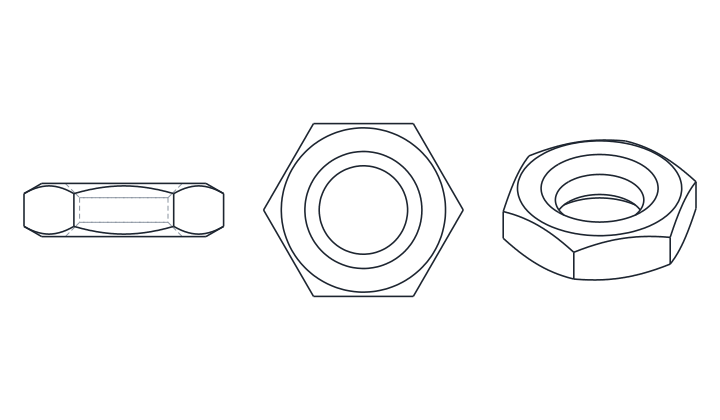 ISO 4035 / DIN 439 thin hex nutThin hexagon nut (jam nut), chamfered both sides, from M3 to M24.
-
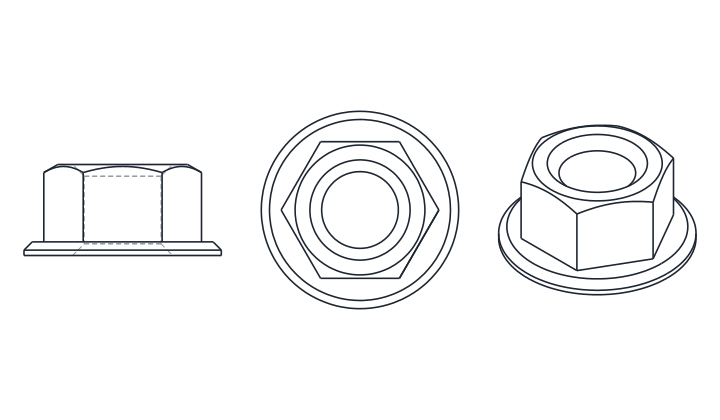 DIN 6923 hex flange nutHexagon nut with an integral flange that acts as a washer, from M5 to M20.
-
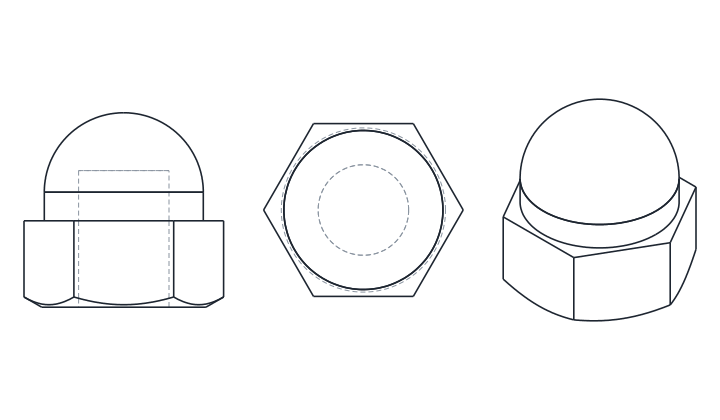 DIN 1587 hex domed cap nutTall hexagon cap nut with a closed dome, used to cover the end of a bolt, from M4 to M24.
Metric nut size chart from M3 to M24
Across flats (s) is the spanner size, and the height is the maximum of each standard (m for open nuts, h for the overall height of the lock nut and the cap nut). At a given thread the five types take the same spanner, with one exception: the DIN 6923 flange nut at M10 is 15 mm across flats instead of 16.
| Thread | Pitch Pcoarse, mm | Wrench size sISO 4032, mm | Hex nut mISO 4032, mm | Thin nut mISO 4035, mm | Nylon insert nut hISO 10511, mm | Flange nut mDIN 6923, mm | Flange dcDIN 6923, mm | Cap nut hDIN 1587, mm |
|---|---|---|---|---|---|---|---|---|
| M3 | 0.5 | 5.5 | 2.4 | 1.8 | 3.9 | – | – | – |
| M4 | 0.7 | 7 | 3.2 | 2.2 | 5 | – | – | 8 |
| M5 | 0.8 | 8 | 4.7 | 2.7 | 5 | 5 | 11.8 | 10 |
| M6 | 1 | 10 | 5.2 | 3.2 | 6 | 6 | 14.2 | 12 |
| M8 | 1.25 | 13 | 6.8 | 4 | 6.76 | 8 | 17.9 | 15 |
| M10 | 1.5 | 16 | 8.4 | 5 | 8.56 | 10 | 21.8 | 18 |
| M12 | 1.75 | 18 | 10.8 | 6 | 10.23 | 12 | 26 | 22 |
| M14 | 2 | 21 | 12.8 | 7 | 11.32 | 14 | 29.9 | 25 |
| M16 | 2 | 24 | 14.8 | 8 | 12.42 | 16 | 34.5 | 28 |
| M18 | 2.5 | 27 | 15.8 | 9 | – | – | – | 32 |
| M20 | 2.5 | 30 | 18 | 10 | 14.9 | 20 | 42.8 | 34 |
| M22 | 2.5 | 34 | 19.4 | 11 | – | – | – | 39 |
| M24 | 3 | 36 | 21.5 | 12 | 17.8 | – | – | 42 |
A dash means the standard has no such size. The older DIN 934 hex nut is thinner from M5 up, and like DIN 933 it takes a different spanner at M10, M12, M14 and M22 (17, 19, 22 and 32 mm).
How to measure a metric nut
The size of a nut is the size of the bolt it fits, not its outside. To find it, screw it onto a bolt you know, or measure the bore with a caliper: the reading is the minor diameter of the thread, a little less than the nominal size, roughly 6.6 mm for an M8 nut.
The spanner size is measured across two opposite flats. With the chart above you can go the other way: a 13 mm hexagon is an M8 nut, a 24 mm hexagon an M16. The height tells the types apart. A thin nut is between a half and three quarters of the height of a regular one, and a lock nut is taller because the nylon ring sits on top of the thread.
ISO 4032 and DIN 934 hex nut dimensions
When DIN 934 was replaced by ISO 4032, most hex nuts became taller. At M16, for example, the height goes from 13 mm to 14.8 mm. The ISO heights were set so that a nut of the matching property class does not strip before the bolt breaks. The same four spanner sizes changed as on hex bolts: M10, M12, M14 and M22. Both versions are still on sale, and the ISO 4032 / DIN 934 page has files for each one and a table with the differences.
Metric nut sizes: common questions
- What are the dimensions of an M16 nut?
- An ISO 4032 hex nut M16 is 24 mm across flats, at least 26.75 mm across corners and up to 14.8 mm high. The thread is M16 × 2. A DIN 934 nut M16 has the same spanner size and is up to 13 mm high.
- What spanner do I need for an M8 nut?
- 13 mm, for regular, thin, nylon insert, flange and cap nuts alike. At M8 the spanner size is the same in DIN 934 and ISO 4032.
- What is the difference between DIN 985 and DIN 982 lock nuts?
- Both are nylon insert lock nuts. DIN 985 is the low type and DIN 982 the high type, which has a taller nut body under the insert. This library covers the low type, now standardised as ISO 10511.