
Ball bearing size chart: 6000, 6200, 6300 and miniature bearings
Single row deep groove ball bearings in the three common series and the small 62x and 608 sizes. The chart lines up the three series by bore so you can compare their outside diameter and width; each series has its own page with load ratings and a CAD file for every bearing.
Deep groove ball bearing series
-
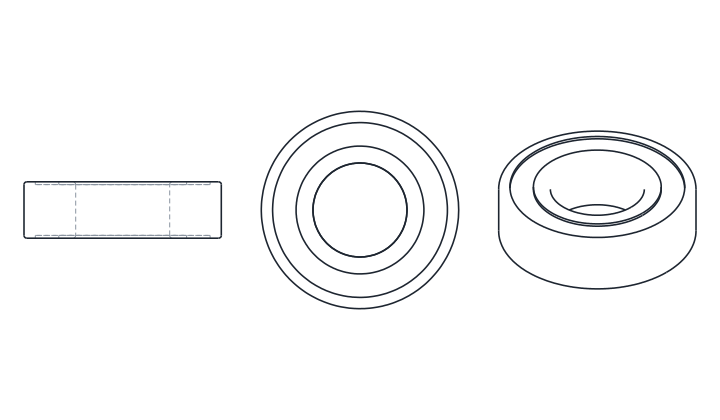 6000 series deep groove ball bearingExtra light single row deep groove ball bearings from 6000 to 6020, with boundary dimensions to ISO 15.
-
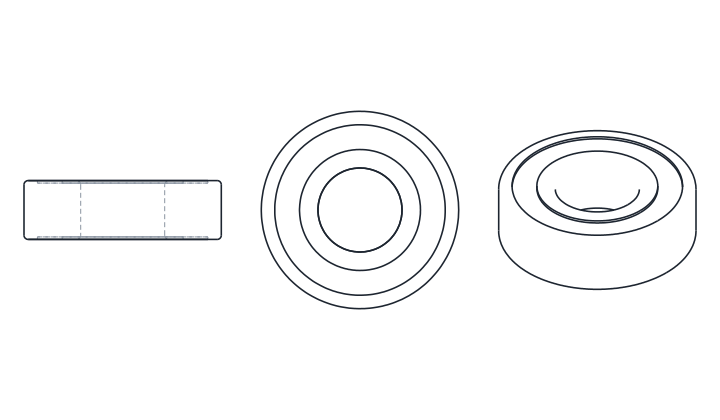 6200 series deep groove ball bearingLight single row deep groove ball bearings from 6200 to 6220, the most common series, with boundary dimensions to ISO 15.
-
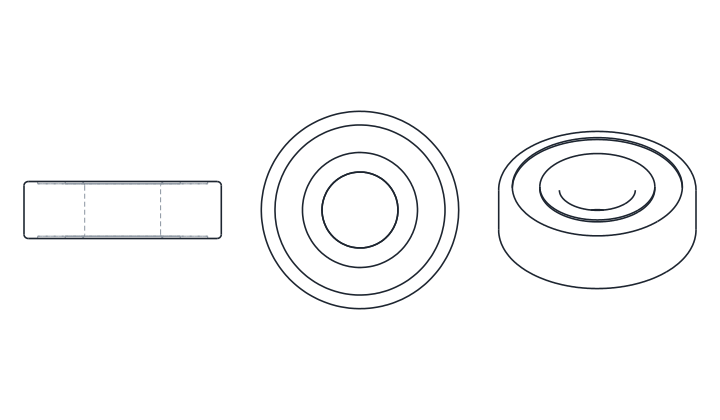 6300 series deep groove ball bearingMedium single row deep groove ball bearings from 6300 to 6320, with boundary dimensions to ISO 15.
-
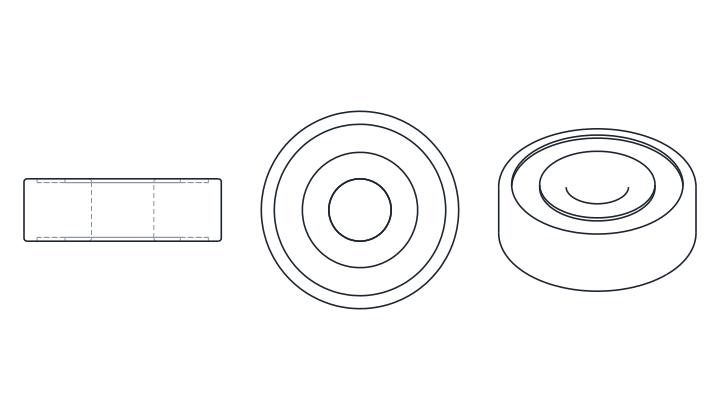 Miniature deep groove ball bearings (623 to 629, 608)Small single row deep groove ball bearings, the 608 and the 623 to 629 sizes, with boundary dimensions to ISO 15.
Deep groove ball bearing size chart by bore
Each row is one bore code, the last two digits of the bearing number. Within a row the bore d is the same and the bearing gets wider and larger in diameter from the 60 to the 63 series, which means more load capacity in a larger housing.
| Bore code | Bore dmm | 60 series Dmm | 60 series Bmm | 62 series Dmm | 62 series Bmm | 63 series Dmm | 63 series Bmm |
|---|---|---|---|---|---|---|---|
| 00 | 10 | 26 | 8 | 30 | 9 | 35 | 11 |
| 01 | 12 | 28 | 8 | 32 | 10 | 37 | 12 |
| 02 | 15 | 32 | 9 | 35 | 11 | 42 | 13 |
| 03 | 17 | 35 | 10 | 40 | 12 | 47 | 14 |
| 04 | 20 | 42 | 12 | 47 | 14 | 52 | 15 |
| 05 | 25 | 47 | 12 | 52 | 15 | 62 | 17 |
| 06 | 30 | 55 | 13 | 62 | 16 | 72 | 19 |
| 07 | 35 | 62 | 14 | 72 | 17 | 80 | 21 |
| 08 | 40 | 68 | 15 | 80 | 18 | 90 | 23 |
| 09 | 45 | 75 | 16 | 85 | 19 | 100 | 25 |
| 10 | 50 | 80 | 16 | 90 | 20 | 110 | 27 |
| 11 | 55 | 90 | 18 | 100 | 21 | 120 | 29 |
| 12 | 60 | 95 | 18 | 110 | 22 | 130 | 31 |
| 13 | 65 | 100 | 18 | 120 | 23 | 140 | 33 |
| 14 | 70 | 110 | 20 | 125 | 24 | 150 | 35 |
| 15 | 75 | 115 | 20 | 130 | 25 | 160 | 37 |
| 16 | 80 | 125 | 22 | 140 | 26 | 170 | 39 |
| 17 | 85 | 130 | 22 | 150 | 28 | 180 | 41 |
| 18 | 90 | 140 | 24 | 160 | 30 | 190 | 43 |
| 19 | 95 | 145 | 24 | 170 | 32 | 200 | 45 |
| 20 | 100 | 150 | 24 | 180 | 34 | 215 | 47 |
Read across a row to build the number: bore code 04 is 6004, 6204 or 6304, all with a 20 mm bore.
How to read a ball bearing number
In a number such as 6204, the first digit 6 means a single row deep groove ball bearing. The second digit is the series: 0 is the extra light 6000 series, 2 the light 6200 series and 3 the medium 6300 series. The last two digits are the bore code.
From 04 upwards the bore is the code times five: 04 is 20 mm, 05 is 25 mm, 20 is 100 mm. The first four codes are the exception: 00 is 10 mm, 01 is 12 mm, 02 is 15 mm and 03 is 17 mm. Letters after the number, such as shields or seals, are the maker's suffixes and do not change the boundary dimensions.
Bore, outside diameter, width and chamfer are fixed by ISO 15, so a 6204 has the same size from any maker. Load ratings are not standardised, which is why each series page shows them as the range found across several makers' catalogues.
Miniature bearing sizes: 623 to 629 and 608
In the miniature 62x sizes the last digit is the bore in millimetres: a 623 has a 3 mm bore, a 626 a 6 mm bore. The 608, at 8 × 22 × 7 mm, is the bearing of skateboard and inline skate wheels and of many small machines, and shares its outside diameter and width with the 627.
Ball bearing sizes: common questions
- What size is a 6204 bearing?
- 20 mm bore, 47 mm outside diameter and 14 mm wide, with a minimum chamfer of 1 mm. The 6004 has the same bore at 42 × 12 mm, and the 6304 at 52 × 15 mm.
- How do I find a bearing from its dimensions?
- Measure the bore, the outside diameter and the width. Find the bore in the chart, then the column whose outside diameter and width match: that gives the series and the number.
- What does the CAD file of a bearing show?
- A simplified bearing with both rings, their chamfers and flat shields on both sides, at the exact boundary dimensions. It is meant for assemblies and drawings and does not model the balls or the cage.