
ISO 2338 parallel pin (DIN 7): dimensions and lengths
Unhardened cylindrical pin with chamfered ends, from 2 to 20 mm diameter, in the stock lengths of each diameter. Pick the diameter and the length to download its CAD files.
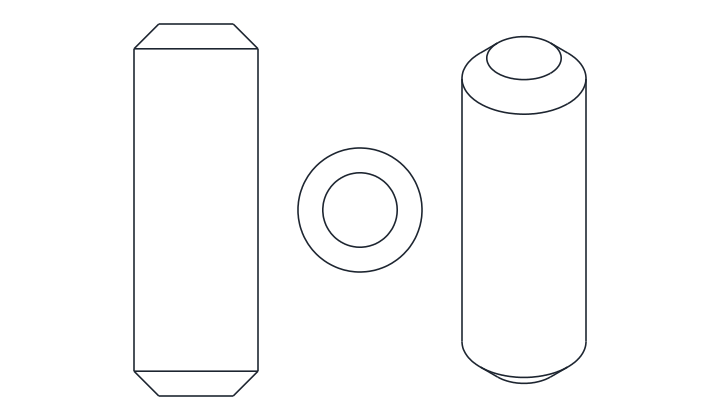
ISO 2338 dimensions: chamfer and length range
| d | capprox, mm | lfrom, mm | lto, mm |
|---|---|---|---|
| 2 | 0.35 | 16 | 16 |
| 3 | 0.5 | 8 | 24 |
| 4 | 0.63 | 8 | 30 |
| 5 | 0.8 | 10 | 50 |
| 6 | 1.2 | 12 | 40 |
| 8 | 1.6 | 16 | 60 |
| 10 | 2 | 20 | 60 |
| 12 | 2.5 | 24 | 32 |
| 16 | 3 | 40 | 60 |
| 20 | 3.5 | 40 | 40 |
Dimensions in millimetres unless stated. Select a row to load its CAD files above.
ISO 2338 and DIN 7
DIN 7 was replaced by ISO 2338. The diameter and lengths are the same; the size of the end chamfer c is slightly different in some diameters. The files follow ISO 2338.
ISO 2338 m6 and h8 tolerance
The pin is made in two tolerance classes on the diameter, m6 and h8, and the class is part of the designation: ISO 2338 – 6 m6 × 30 is a 6 mm pin, 30 mm long, in m6. The m6 pin is slightly over its nominal size and is the one for press fits that locate parts; h8 is at or under nominal and suits looser fits. The CAD model is drawn at the nominal diameter.
ISO 2338 pins are not hardened. For locating hardened parts or where wear matters, the hardened ISO 8734 dowel pin is the usual alternative.
ISO 2338 pins: common questions
- What is the difference between ISO 2338 m6 and h8?
- The tolerance on the diameter. An m6 pin is slightly larger than nominal and is pressed into a reamed hole; an h8 pin is at or below nominal and gives a looser fit.
- Is DIN 7 the same as ISO 2338?
- Practically. ISO 2338 replaced DIN 7 with the same diameters and lengths; only the end chamfer differs slightly in some sizes.